
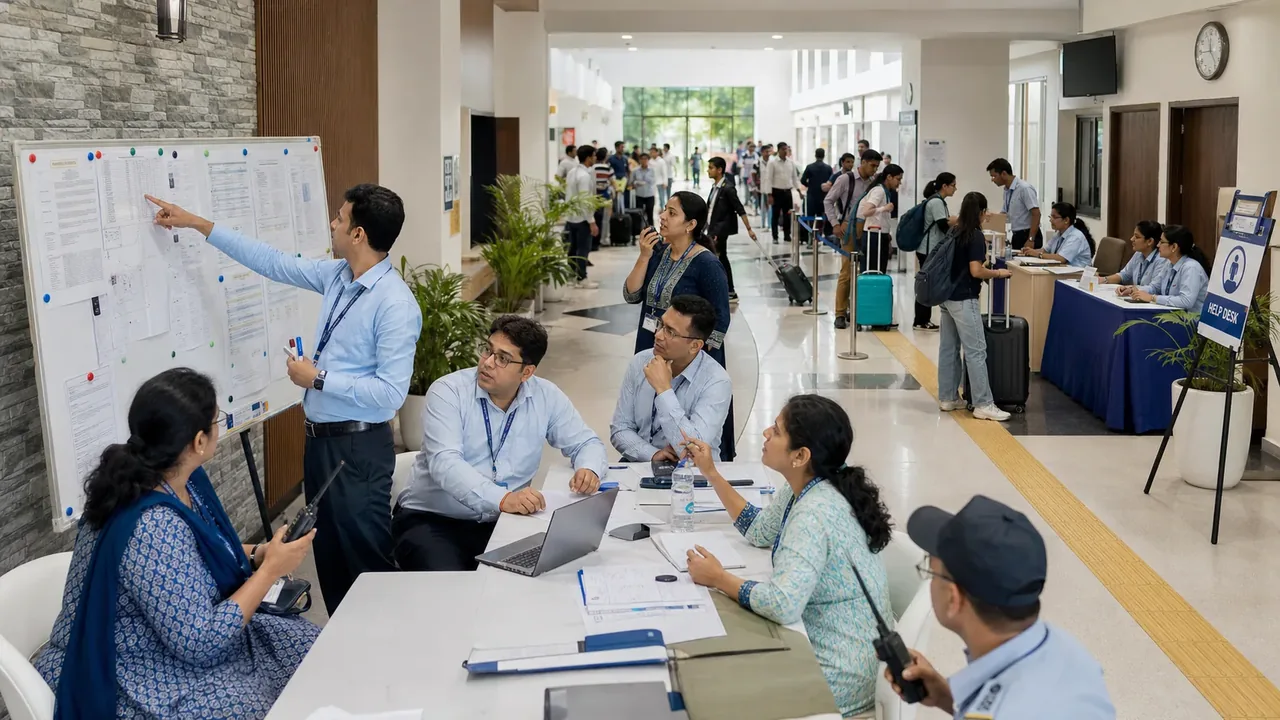
Opening day needs one shared operating picture and rapid exception ownership—not a larger collection of disconnected help desks.
Arrival day is a live operation across admissions, finance, hostel, facilities, security, IT and student welfare. The command centre is not a ceremonial room; it is the mechanism for seeing pressure early and assigning exceptions without sending students between departments.
Define authority before the doors open
- Name the command lead and shift backups.
- Place authorised decision-makers for allotment, finance, rooms, access and welfare within reach.
- Publish escalation thresholds for room failure, crowding, system outage, missing resident and medical or safety concern.
- Create one timestamped log of important decisions and unresolved cases.
Design two arrival flows
Use a fast lane for pre-verified standard arrivals and an accessible exception lane for mismatches. Keep luggage, parents and waiting residents out of narrow processing areas. Provide seating, water, toilets, shade and priority assistance appropriate to the location and season.
Information the command centre must see
- Expected and completed arrivals by reporting window.
- Queue length, waiting time and counter capacity.
- Rooms blocked, not ready or changed after allotment.
- Payment, identity, accommodation and access exceptions.
- Students needing welfare, language, disability or travel support.
- Critical complaints, utility failures and security incidents.
Communicate without creating noise
Use one verified internal channel for operational updates and one approved public channel for students. State what happened, who is affected, the immediate arrangement and the next update time. Avoid forwarding names, medical information or allegations beyond those who need them.
Prepare failure playbooks
- Room unavailable: safe temporary room, belongings support and repair owner.
- System offline: controlled manual verification and later reconciliation.
- Payment mismatch: no repeated queues; finance resolves behind one case.
- Late arrival: safe after-hours reporting and equivalent induction.
- High crowding: pause inflow, open overflow waiting and redeploy trained staff.
- Distress or medical concern: privacy, trained response and professional escalation.
Shift handover and end-of-day control
Reconcile actual occupancy, issued credentials, unresolved exceptions, temporary rooms, missing expected arrivals and defects before each handover. The incoming lead must know the risk, next action, owner and escalation trigger—not receive a rumour-filled narrative.
Opening-day checklist
- Command roles, contact tree and decision authority confirmed.
- Standard and exception routes tested for accessibility.
- Counters, connectivity, credentials and manual fallback ready.
- Facilities, security, first response and transport coverage confirmed.
- Student messages and next-update ownership approved.
- Live measures reviewed at fixed intervals.
- End-of-shift occupancy and open-case reconciliation completed.
Conclusion
A good opening day is not one without exceptions. It is one where exceptions remain visible, students receive humane support and the institution coordinates behind the case instead of transferring its complexity to the resident.
Official references
- Primary sources reviewed 22 August 2026:
- UGC Deeksharambh: A Guide to Student Induction Programme
- Ministry of Home Affairs: Emergency Response Support System 112
- DEPwD: notified accessibility standards and guidelines
- Implementation note: tailor thresholds and authority to the institution's approved emergency, finance, admission and accommodation procedures.
Revision history
Editorial language, consistency and source audit completed. India-specific operating context retained.
See something we should improve?
Point out a correction, add a missing perspective or share a stronger source.