
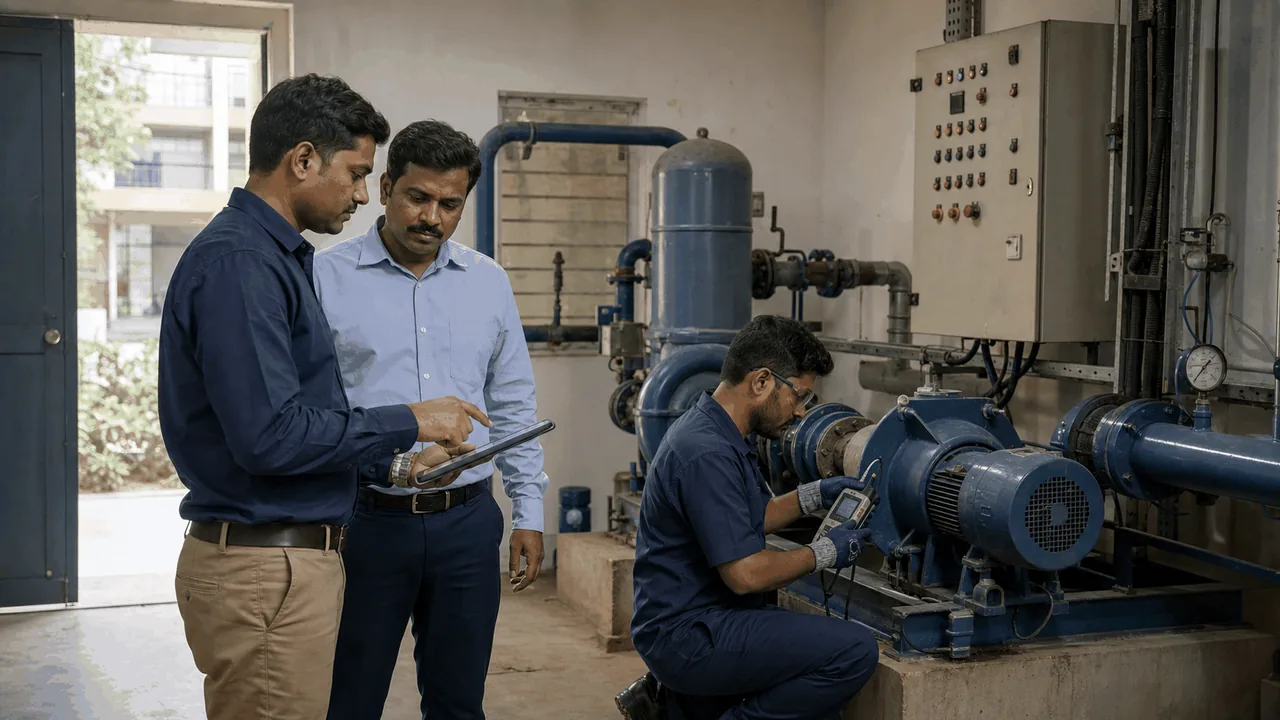
Predictive maintenance is not an AI dashboard added to poor records. It is a decision process that combines critical assets, reliable condition data, qualified thresholds and a work team able to act before failure.
A campus pump can reveal rising vibration before seizure; an electrical connection can show abnormal heat; a water system can reveal pressure or consumption drift. Condition monitoring can convert these signals into planned intervention.
But more sensors do not automatically create fewer failures. The university first needs trusted asset identity, maintenance history, competent interpretation and a clear response to each alert.
Choose the right candidates
Rank assets by safety, service impact, failure cost, redundancy and detectability. Good candidates often include rotating equipment, pumps, motors, HVAC components, electrical panels and selected water systems—subject to qualified engineering assessment and statutory requirements.
Do not instrument every asset. A low-cost item with obvious failure and easy replacement may be better served by inspection or run-to-failure, while a critical pump with measurable degradation can justify monitoring.
Establish a trustworthy baseline
Clean asset identities, failure codes, work history, runtime and operating context. Select condition indicators such as vibration, temperature, current, pressure, flow, run hours, power quality or water parameters according to the failure mode.
Collect enough normal operating data across seasons and loads. A threshold copied from another campus may create false alarms or miss local deterioration.
Convert alerts into maintenance decisions
Define who validates an alert, what inspection follows, how urgency is set, which work order is created and how completion feeds the model. Use rule-based thresholds first where they solve the problem; machine learning is not mandatory.
Qualified engineers should set safety limits and interpret complex conditions. An automated alert must never override statutory tests, manufacturer instructions or competent judgement.
Pilot, measure and govern
Pilot on a small critical asset group with known failure history. Measure avoided downtime, warning lead time, false positives, maintenance cost, data availability and whether the team acted in time. Compare against a credible baseline.
Secure devices and networks, restrict access and define ownership of vendor data. Review sensor calibration, missing data and model drift. Scale only where the operating benefit survives the full lifecycle cost.
Common failure modes to avoid
- Buying sensors before the asset register is reliable.
- Treating every anomaly as an emergency.
- Training a model on inconsistent failure codes.
- Ignoring alarms because the maintenance team lacks capacity or spares.
- Claiming savings from failures that were never likely to occur.
Predictive-maintenance pilot checklist
- Critical asset and failure mode are explicitly selected.
- Baseline history and condition indicator are credible.
- Alert validation and work-order response are assigned.
- Safety and statutory maintenance remain unchanged.
- False alerts, missed events and data gaps are reviewed.
- Benefit is measured against hardware, software and operating cost.
Frequently asked questions
Does predictive maintenance require artificial intelligence? No. Trend rules, thresholds and qualified condition analysis often create value. Use more complex models only when they improve a defined decision.
Which assets should be monitored first? Choose critical, expensive-to-fail assets with detectable degradation and an actionable maintenance window—not the assets easiest to connect.
Can prediction replace preventive maintenance? Only where qualified engineering evidence supports a changed strategy. Statutory, safety and manufacturer requirements still apply.
Conclusion
Prediction creates value only when it changes a maintenance action early enough to matter. A focused pilot with clean records and qualified ownership is more useful than a campus-wide sensor spectacle.
Official references
- Primary sources for publication and implementation review (accessed 20 August 2026):
- Bureau of Energy Efficiency: programmes, standards and guidance
- Bureau of Indian Standards: National Building Code of India 2016
- MeitY: Digital Personal Data Protection Act, Rules and policy material
- Implementation note: Operational guidance only. Confirm current central, state, local and university requirements and obtain qualified finance, legal, food-safety, procurement, engineering, environmental, information-security or occupational-safety review as applicable.
Revision history
Editorial language, consistency and source audit completed. India-specific operating context retained.
See something we should improve?
Point out a correction, add a missing perspective or share a stronger source.