
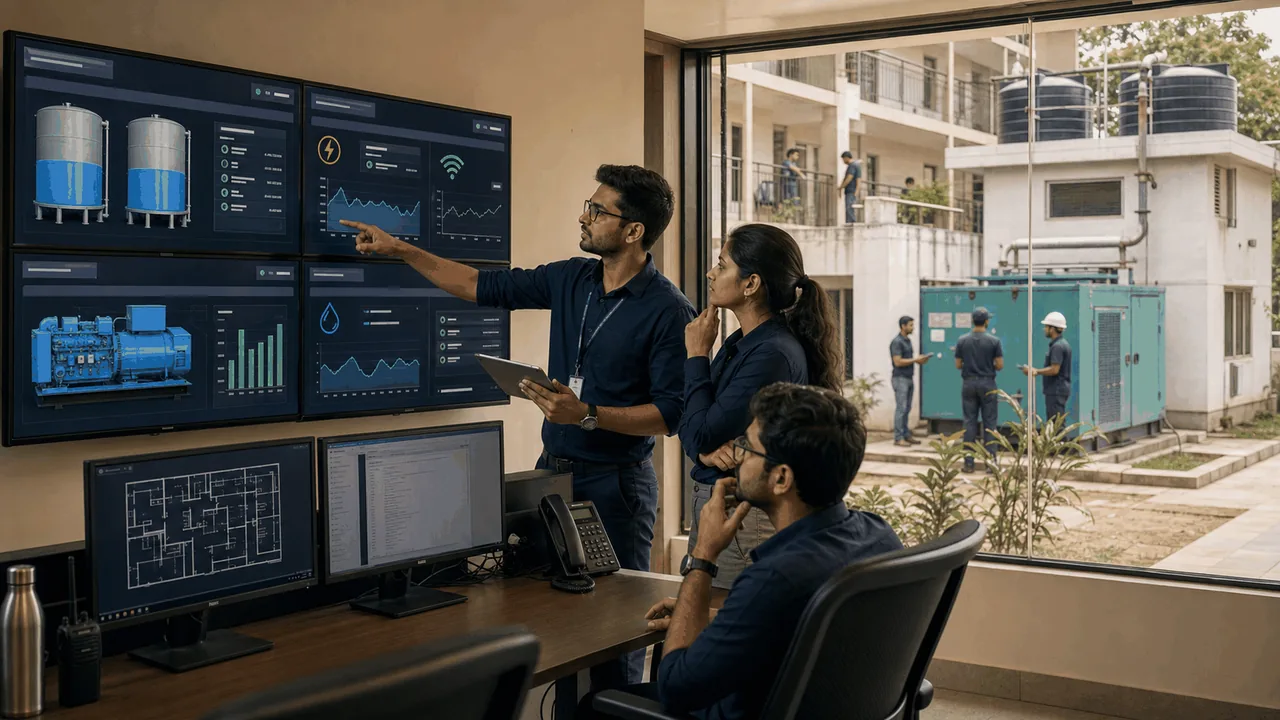
Utilities are resident services, not invisible engineering inputs. Each needs a service owner, measurable operating range, safe fallback, outage communication and a restoration record.
Water, electricity and connectivity shape every hour of hostel life. A short interruption can affect sanitation, access control, lifts, study, medical equipment, food service and resident safety.
Utilities cross organisational boundaries: engineering owns equipment, IT owns networks, vendors may operate infrastructure and wardens communicate with residents. A single service map prevents gaps during an outage.
Define service standards and ownership
For each utility, document source, distribution path, critical assets, normal operating range, monitoring, duty owner, vendor contact, dependencies and restoration priority. Identify vulnerable residents and functions that require continuity.
Measure availability and quality, not only monthly cost. Define what residents should expect, how planned shutdowns are announced and which conditions require immediate escalation.
Control water and sanitation services
Map source, storage, treatment, pumps, distribution, drainage and quality sampling. Inspect tanks and critical valves under approved schedules, protect potable supply, investigate pressure and consumption anomalies and respond rapidly to contamination concerns.
Use a water audit to establish balance, high-use areas and leakage. Any reuse system must remain segregated, labelled and designed to the applicable technical and public-health requirements.
Control power, backup and electrical risk
Maintain distribution, protection, earthing, backup generation or storage and fuel arrangements through competent electrical professionals. Prioritise life-safety and essential loads and test transfer or backup systems under controlled conditions.
Track load, demand peaks, outages and repeated trips. Residents should have clear rules for high-load appliances, but behavioural messaging must not replace correction of unsafe or undersized infrastructure.
Run Wi-Fi as a capacity and availability service
Measure coverage, concurrent use, authentication success, throughput, latency and outage by building and time—not merely the internet link capacity. Separate resident, administrative, device and guest networks according to security design.
Publish acceptable-use, privacy and support routes. During failure, distinguish campus network, access point, authentication, upstream provider and power causes so updates are accurate.
Common failure modes to avoid
- Communicating only after residents have formed their own outage narrative.
- Reporting water availability without testing quality and pressure.
- Restoring a tripped circuit repeatedly without fault investigation.
- Buying more internet bandwidth when local coverage is the bottleneck.
- Keeping utility dependencies and isolation points in one person's memory.
Utility resilience dashboard
- Availability, outage count, duration and residents affected.
- Water storage, quality exceptions, leakage and consumption intensity.
- Power demand, backup readiness, fuel and repeated trips.
- Wi-Fi coverage, authentication, capacity and support incidents.
- Planned shutdown notices and restoration updates.
- Critical utility risks, temporary controls and capital actions.
Frequently asked questions
What should residents be told during an outage? State the affected service and area, safety instructions, temporary arrangement, responsible team and next update time. Do not invent a restoration time before the fault is assessed.
Should hostels meter utilities by building? Sub-metering can reveal leaks, peaks and abnormal consumption where technically and economically justified. It should support improvement, not become a substitute for maintaining service.
Who owns hostel Wi-Fi complaints? Residents need one intake route, while IT should diagnose whether the issue is device, access point, authentication, local network, power or upstream service.
Conclusion
Utility reliability improves when engineering status becomes operational information. Defined standards, dependencies, fallbacks and timely communication turn outages from confusion into controlled restoration.
Official references
- Primary sources for publication and implementation review (accessed 20 August 2026):
- Ministry of Jal Shakti / Central Water Commission: water audit and conservation guidance
- Bureau of Energy Efficiency: programmes, standards and guidance
- Bureau of Indian Standards: National Building Code of India 2016
- MeitY: Digital Personal Data Protection Act, Rules and policy material
- Implementation note: Operational guidance only. Confirm current central, state, local and university requirements and obtain qualified finance, legal, food-safety, procurement, engineering, environmental, information-security or occupational-safety review as applicable.
Revision history
Editorial language, consistency and source audit completed. India-specific operating context retained.
See something we should improve?
Point out a correction, add a missing perspective or share a stronger source.