
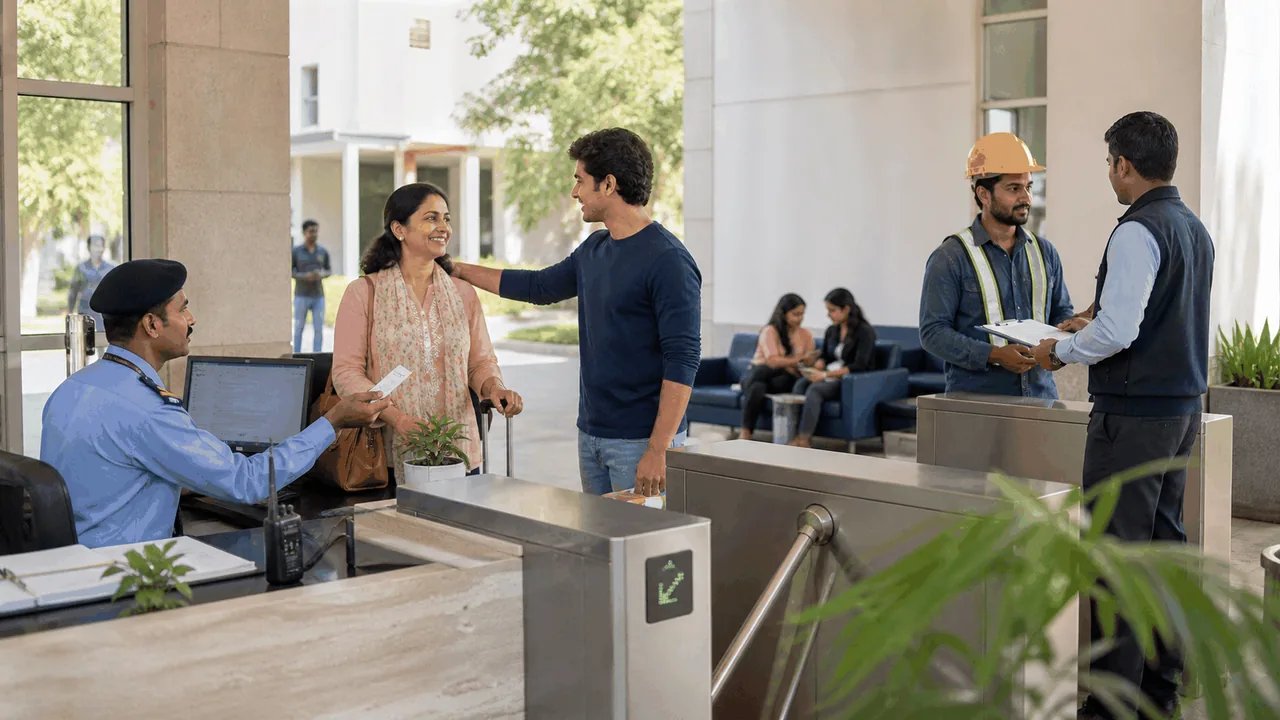
Visitor management should answer who entered, why, where they may go, who hosts them and whether they have left - without turning reception into an intrusive checkpoint.
University hostels receive parents, guardians, friends, vendors, alumni, delivery personnel and institutional visitors. Treating every person identically creates friction; treating access casually creates safety and accountability gaps.
A visitor policy should classify purpose and access, verify only what is needed and make the host's responsibilities clear.
Why this matters in an Indian university hostel
A visitor register is useful only if it supports a specific access decision and an accurate on-site list. Collecting more identity data does not automatically improve security; it can increase privacy, storage and misuse risk.
Design separate paths for personal visitors, parents, contractors, deliveries, institutional guests and emergency access. Each path should specify the host, permitted zone, time window, verification level and exit control.
Create visitor categories
- Personal visitor hosted by a resident.
- Parent or guardian visit.
- University staff or official guest.
- Vendor, contractor or maintenance worker.
- Delivery or short-duration service access.
- Emergency responder or authorized authority.
Each category needs permitted hours, zones, verification, host or sponsor, escort and exit confirmation.
The standard visit flow
Pre-registration can speed arrival but should not be mandatory for emergencies or reasonable exceptions. At entry, verify identity as required, confirm the host, issue time-bound access and communicate permitted areas.
Record exit or credential return. An open visitor record after the expected time should trigger reconciliation, not immediate accusation.
Protect residential privacy
Visitors should not move through sleeping or private areas without authorization. Contractors require work orders, supervision and access limited to the task.
Do not display resident room numbers, phone numbers or movement details at the gate. Contact the host through an approved channel.
Design exceptions
Examples include a parent arriving after long-distance travel, a support person for a resident with a disability, emergency medical access, a vendor responding to an essential-service failure or a group visit approved by the institution.
Name who can approve each exception and what compensating controls apply.
Fairness and dignity
Apply rules consistently across gender, nationality, social status and visitor appearance. Any differentiated restriction should have a clear institutional basis and review.
Train security staff in respectful communication and de-escalation. A visitor denied entry should receive a concise reason and route for authorized review.
Common failure modes to avoid
Before opening visitor access, test the process against these common failure patterns:
- Keeping copies of government identity documents by default without a necessity and retention decision.
- Displaying room numbers or resident phone numbers at the gate.
- Letting contractor access operate as an ordinary personal visit without work-order controls.
- Applying visitor rules inconsistently based on gender, status, nationality or appearance.
Visitor dashboard
- Visitors currently on site by category.
- Overdue exits and unreturned credentials.
- Denied or exception entries by reason.
- Contractors in residential zones.
- Repeat host or access violations.
- System outages and manual records awaiting reconciliation.
Gate checklist
- Current visitor policy displayed clearly.
- Accessible waiting and verification process.
- Host confirmation protects resident data.
- Credentials expire automatically where possible.
- Contractor work order and escort checked.
- End-of-shift open visits reconciled.
Frequently asked questions
Should every visitor submit a government-ID copy? Verify the institution-specific necessity and legal basis; retaining copies creates additional privacy and security obligations.
Can deliveries enter residential floors? Prefer designated handover points unless an accessibility, medical or operational exception is approved.
Who is responsible for the visitor? The host or institutional sponsor has defined responsibilities, while the university retains its own safety and access-control duties.
Conclusion
A proportionate visitor system gives security staff enough information to make the right access decision while protecting the resident's home-like privacy. Classification, time-bound access and exit reconciliation are stronger controls than indiscriminate data collection.
Official references
- Primary sources for publication and implementation review (accessed 17 August 2026):
- MeitY: Digital Personal Data Protection Rules, 2025 and phased enforcement material
- DEPwD: notified accessibility standards and guidelines, including higher education
- UGC student-centric regulations, including student grievance and anti-ragging regulations
- Implementation note: This article provides operational guidance, not institution-specific legal advice. Confirm the provisions currently in force, plus applicable state, local and university requirements.
Revision history
Editorial language, consistency and source audit completed. India-specific operating context retained.
See something we should improve?
Point out a correction, add a missing perspective or share a stronger source.