
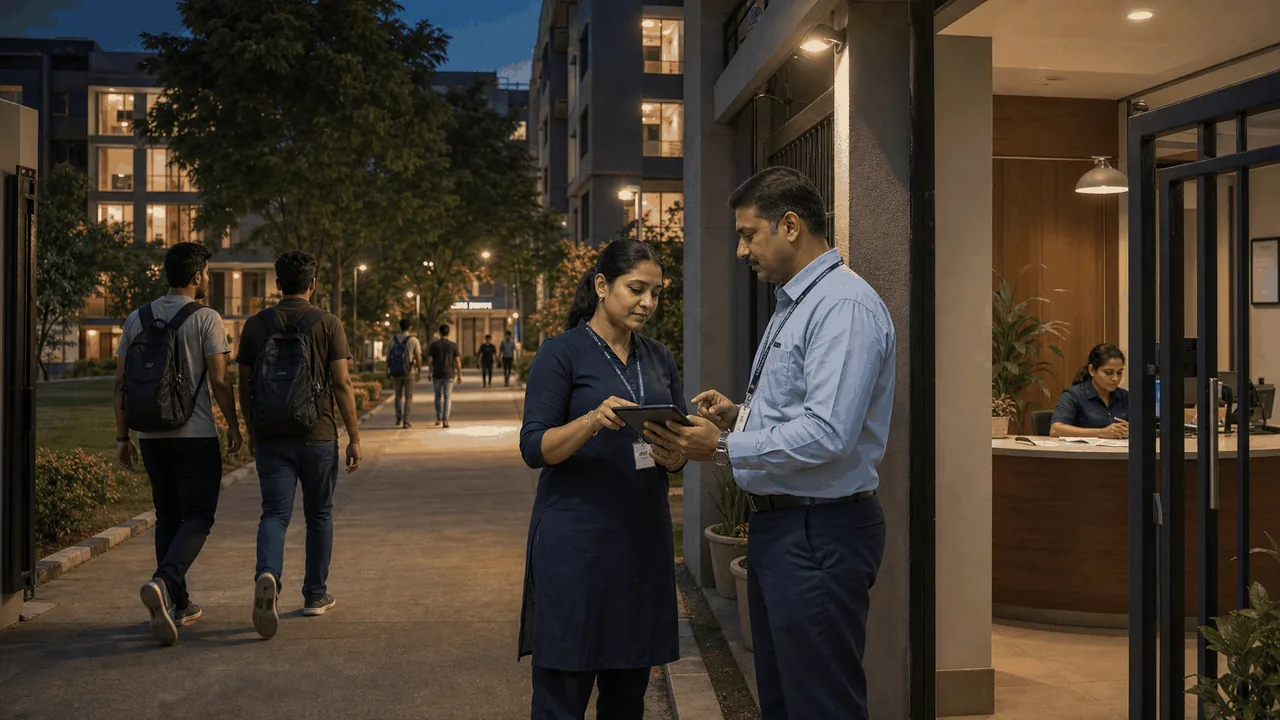
Hostel security should reduce risk through layered, respectful controls—not through arbitrary restrictions, intimidation or invisible surveillance.
Residential security must protect people without turning the hostel into a punitive environment. Gates, credentials, visitors, keys, patrols, lighting, CCTV and emergency escalation are connected controls; weakness in one area shifts pressure to the others.
The university should define decision rights between wardens, security supervisors, campus leadership and external emergency services, particularly after office hours.
Build security from a documented risk assessment
Map entrances, isolated paths, perimeter gaps, common areas, critical assets, late-night movement, delivery points, construction activity and known incident patterns. Involve residents, wardens, facilities and security teams.
Prioritise physical design and reliable processes before adding surveillance. Lighting, locks, visibility, staffing and maintenance often solve risks more directly.
Operate the gate as a controlled service point
Verify residents and authorised staff, register visitors under published rules, manage deliveries separately and provide an exception route for lost credentials or emergency access. Avoid collecting unnecessary identity data.
Gate staff need clear authority for denial, temporary holding, supervisor escalation and emergency entry. Every override should be attributable and reviewable.
Design useful patrols and handovers
Patrol plans should specify purpose, route, frequency range, high-risk checks and exception reporting rather than rewarding only scanned checkpoints. Vary predictable patterns where appropriate while preserving accountability.
Each shift should hand over open incidents, missing keys, faulty cameras or lights, restricted areas, expected visitors, vulnerable locations and pending law-enforcement or medical matters.
Use CCTV and access data proportionately
Define the purpose, coverage, retention, access, export authority and incident-use procedure for surveillance systems. Avoid cameras in private residential spaces and prevent casual viewing or sharing.
Security data can be incomplete and should not be treated as automatic proof. Preserve relevant material lawfully and route potential offences through authorised processes.
Common failure modes to avoid
- Relying on uniformed presence without clear procedures.
- Allowing master keys, access cards or visitor passes to remain unaccounted.
- Using patrol completion as the only security-quality measure.
- Keeping CCTV indefinitely or exporting clips informally.
- Expecting gate staff to resolve serious incidents without supervisor support.
Security control checklist
- Current risk map and incident trends reviewed.
- Gate, visitor, delivery and lost-credential exceptions documented.
- Keys and access privileges reconciled.
- Night patrol and shift handover records verified.
- CCTV purpose, retention and access controls approved.
- Emergency numbers, responder routes and escalation drills tested.
Frequently asked questions
Should every resident movement be monitored? Controls should be necessary, proportionate and transparent. Safety does not justify unlimited collection or use of movement data.
What if a resident refuses a security instruction? Staff should explain the published rule, avoid escalation through humiliation and involve the designated warden or supervisor. Immediate danger follows the emergency protocol.
When should 112 be called? Use 112 for police, fire, medical or other emergency assistance when the situation meets emergency thresholds; do not wait for routine hierarchy in an immediate threat.
Conclusion
Good hostel security is predictable to residents and resilient to incidents. It combines design, trained people, controlled access, respectful communication, reliable handovers and proportionate data use.
Official references
- Primary sources for publication and implementation review (accessed 20 August 2026):
- Ministry of Home Affairs: Emergency Response Support System 112
- Ministry of Home Affairs: policies, security systems and Safe City guidance
- MeitY: Digital Personal Data Protection Act and policy material
- UGC student-centric regulations, including anti-ragging, grievance and sexual-harassment regulations
- Implementation note: Operational guidance only. Confirm current central, state, local and university requirements and obtain qualified legal, clinical, fire-safety, accessibility or safeguarding review as applicable.
Revision history
Editorial language, consistency and source audit completed. India-specific operating context retained.
See something we should improve?
Point out a correction, add a missing perspective or share a stronger source.