
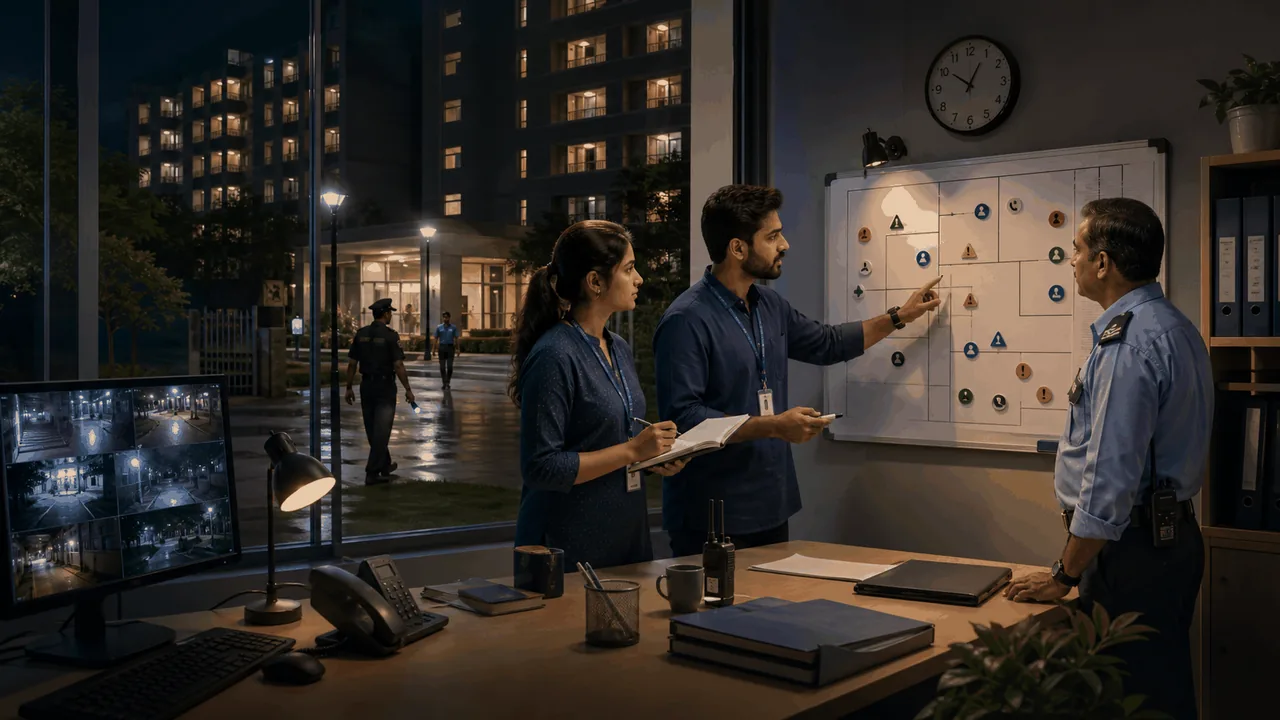
The night shift must inherit a verified operating picture, not a collection of informal messages.
Hostel risk does not follow office hours. Medical emergencies, missing residents, access problems, water failures, fire alarms, conflicts and distressed students often arise at night, when fewer people are present and senior leaders are off site.
A night-duty SOP should help the duty team make safe first decisions, preserve information and escalate without hesitation. It should be short enough to use under pressure and detailed enough to prevent improvisation.
Why this matters in an Indian university hostel
Night duty is a resilience function. The team must be able to manage the first phase of a medical event, missing resident, fire-system impairment, utility failure, conflict or access problem before daytime specialists arrive.
The SOP should distinguish immediate life-safety action from internal notification. Staff should never wait for administrative approval before calling emergency services when delay would increase harm.
Minimum night-duty coverage
Define the duty warden or responsible officer, security supervisor, caretaker or facility contact, medical contact, transport or ambulance arrangement and senior on-call authority. Coverage must account for weekly offs, leave and simultaneous incidents.
Publish one controlled on-call directory with primary and backup contacts. Test it regularly. A list that contains outdated numbers is a hidden failure.
The mandatory handover
The outgoing and incoming duty personnel should review the handover together whenever possible. The incoming person confirms receipt and clarifies uncertain items. The record should include:
- Residents in hospital, on emergency leave, missing, overdue or requiring welfare follow-up.
- Visitors, contractors and temporary occupants still on site.
- Fire-system impairments, blocked exits, electrical hazards and inaccessible areas.
- Water, power, lift, internet, sanitation or access-control failures.
- Serious complaints, conflicts, disciplinary restrictions and evidence requiring preservation.
- Vacant, sealed, isolated or unavailable rooms and master-key status.
- Expected late arrivals, group movements and campus events.
Classify events by action, not by emotion
Use simple priority levels. Priority 1 means immediate threat to life, safety or essential services and requires action plus senior escalation. Priority 2 needs prompt intervention during the shift and active monitoring. Priority 3 can enter the next working queue with a documented temporary response.
The classification should be based on impact and urgency. A loudly expressed complaint is not automatically higher priority than a silent fire-door defect.
The escalation sequence
- Make the area safe and call emergency services when required.
- Notify the designated internal response role.
- Record time, location, people involved, observations and immediate action.
- Preserve CCTV, access logs, photographs or physical evidence where appropriate and authorized.
- Inform the next authority if the first contact does not respond within the defined time.
- Continue monitoring until responsibility is formally handed over.
- Complete the incident record and ensure next-day follow-up.
What the duty team must not do
Night staff should not conduct a detailed disciplinary investigation, make medical diagnoses, promise secrecy, share incident details widely, post information in informal groups or close a serious incident merely because the immediate disturbance has ended.
They should act within training and authority, obtain professional help and document facts without speculation.
End-of-shift reconciliation
Before leaving, reconcile open incidents, late or missing residents, keys, visitors, unavailable rooms and unresolved essential-service issues. Each item needs a status, owner, next action and escalation level.
The morning review should distinguish what was controlled temporarily from what was permanently resolved.
Common failure modes to avoid
- Starting the shift from informal messages instead of a reconciled handover.
- Keeping an on-call directory that is untested, incomplete or dependent on one person.
- Treating every event as equally urgent or escalating based on who complains most loudly.
- Ending the shift without assigning owners for temporary controls and next-day corrective action.
Night-duty audit checklist
- On-call contacts tested this month.
- Duty coverage has a named backup.
- Handover completed and acknowledged.
- Emergency equipment and access routes checked.
- Critical logs are available to authorized night staff.
- All Priority 1 events received management review.
Frequently asked questions
Can the handover be a messaging-group post? A message can alert people, but the official handover should be structured, retained and accessible to authorized successors.
How long should escalation wait? The institution must define incident-specific thresholds. Life-safety cases should never wait for internal approval before emergency help is called.
Who closes a night incident? The role authorized by the relevant process, after permanent action and required follow-up are complete.
Conclusion
A safe night shift inherits a verified operating picture, acts within trained authority and leaves a complete record for the next team. The handover is not a summary of activity; it is the control that keeps unresolved risk from disappearing between shifts.
Official references
- Primary sources for publication and implementation review (accessed 17 August 2026):
- Bureau of Indian Standards: National Building Code of India 2016
- National Anti-Ragging Portal: regulations, compliance material and helpline
- UGC student-centric regulations, including grievance, anti-ragging and student-protection regulations
- MeitY: Digital Personal Data Protection Rules, 2025 and phased enforcement material
- DEPwD: notified accessibility standards and guidelines, including higher education
- Implementation note: Operational guidance only. Confirm current central, state, local and university requirements and obtain qualified review for institution-specific implementation.
Revision history
Editorial language, consistency and source audit completed. India-specific operating context retained.
See something we should improve?
Point out a correction, add a missing perspective or share a stronger source.