
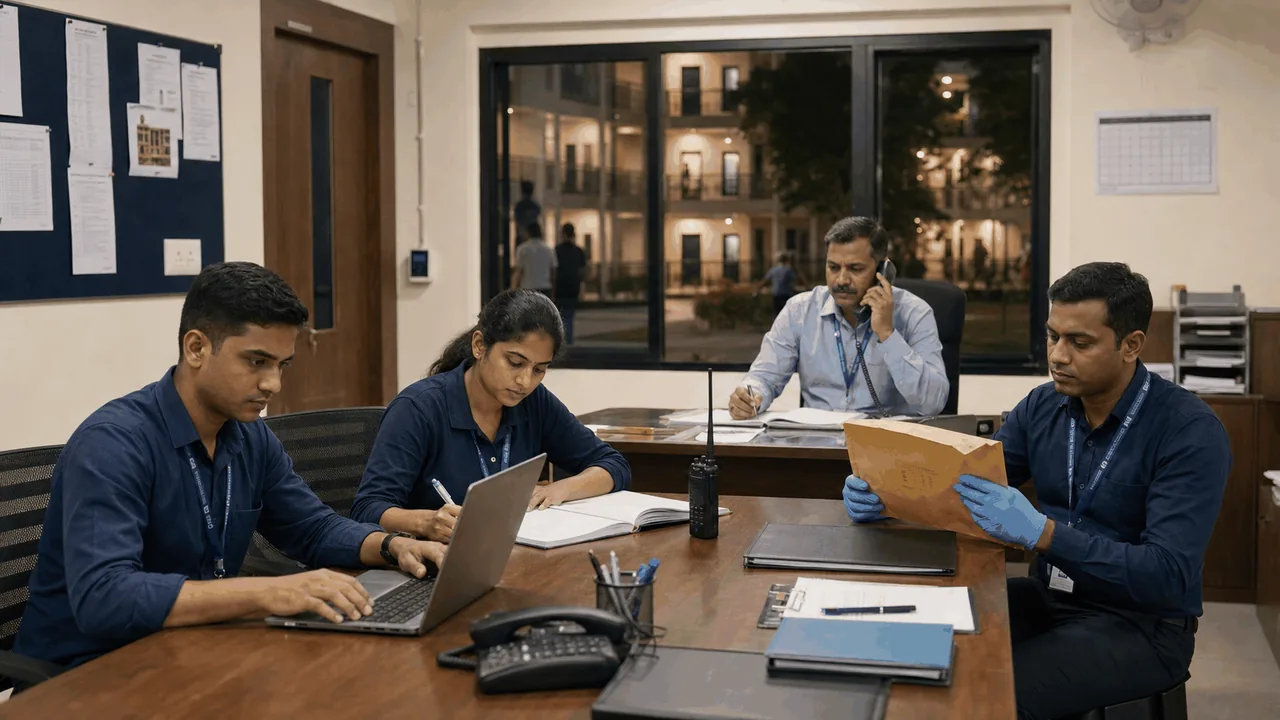
The first incident record should establish what happened, when, where, who may be at risk and what action was taken. It should not contain guesses presented as findings.
An incident is an event requiring immediate control, safety action or formal review: injury, missing resident, violence, serious threat, fire, access breach, suspected offence, self-harm risk, major service failure or another defined event. Good records protect residents and improve decisions; poor records amplify uncertainty.
Response and investigation are different activities. The duty team stabilises the situation and records facts. An authorised reviewer later determines scope, evidence, findings and corrective action.
Define reportable incidents and severity
Publish categories and escalation thresholds so staff do not rely on personal judgement alone. Include near misses and events prevented before harm, because they reveal weak controls.
Severity should consider immediate danger, vulnerability, number of people affected, legal or regulatory duties, service interruption and potential recurrence.
Capture a minimum viable first record
Record date, time, exact location, reporter, people involved, observed condition, exact words where material, immediate hazards, notifications, actions, transfer of care and evidence preserved. Distinguish direct observation from information provided by others.
Use amendments rather than silently rewriting a submitted record. Preserve the original time and author of each entry.
Protect people before protecting the process
Call emergency services, provide first aid within competence, separate immediate risks, preserve dignity and arrange support. Documentation must not delay urgent action.
Notify the approved authority based on category. Potential crime, anti-ragging, sexual harassment, child-safeguarding or other protected matters require their designated pathways.
Investigate with scope and fairness
Appoint an authorised, impartial reviewer; define the question; secure evidence; interview separately; record conflicts; give relevant parties a fair opportunity to respond; and apply the correct standard under university policy and law.
An incident report is not proof of misconduct. Keep safety decisions, fact-finding, disciplinary findings and corrective actions distinct.
Common failure modes to avoid
- Copying rumours into the factual chronology.
- Allowing photographs or medical information to circulate through open groups.
- Editing original records after senior review.
- Using one investigation for issues governed by different mandatory mechanisms.
- Closing after blame is assigned without correcting the failed control.
Incident record and review checklist
- Immediate safety action and escalation timestamps.
- Observed facts separated from statements and assumptions.
- Evidence register with lawful custody and access.
- Support offered to affected residents and staff.
- Finding, corrective action, owner and due date.
- Near-miss and recurrence trends reviewed without exposing identities.
Frequently asked questions
Should every minor event become an incident? Define thresholds. Routine service requests remain complaints, while injury, threat, serious breach, near miss or protected allegation should enter the incident route.
Can staff record a diagnosis or legal conclusion? They should record observable facts and information provided. Clinical diagnoses and legal findings belong to qualified professionals and authorised processes.
How long should records be kept? Follow applicable law, university retention schedules and litigation or investigation holds. Avoid keeping sensitive data indefinitely without a defined purpose.
Conclusion
Incident documentation is useful when it supports rapid safety action, fair review and prevention. The record should help a future reader reconstruct decisions without turning uncertainty into accusation.
Official references
- Primary sources for publication and implementation review (accessed 20 August 2026):
- UGC student-centric regulations, including anti-ragging, grievance and sexual-harassment regulations
- National Anti-Ragging Portal: regulations, advisory material and helpline
- Ministry of Home Affairs: Emergency Response Support System 112
- MeitY: Digital Personal Data Protection Act and policy material
- Implementation note: Operational guidance only. Confirm current central, state, local and university requirements and obtain qualified legal, clinical, fire-safety, accessibility or safeguarding review as applicable.
Revision history
Editorial language, consistency and source audit completed. India-specific operating context retained.
See something we should improve?
Point out a correction, add a missing perspective or share a stronger source.