
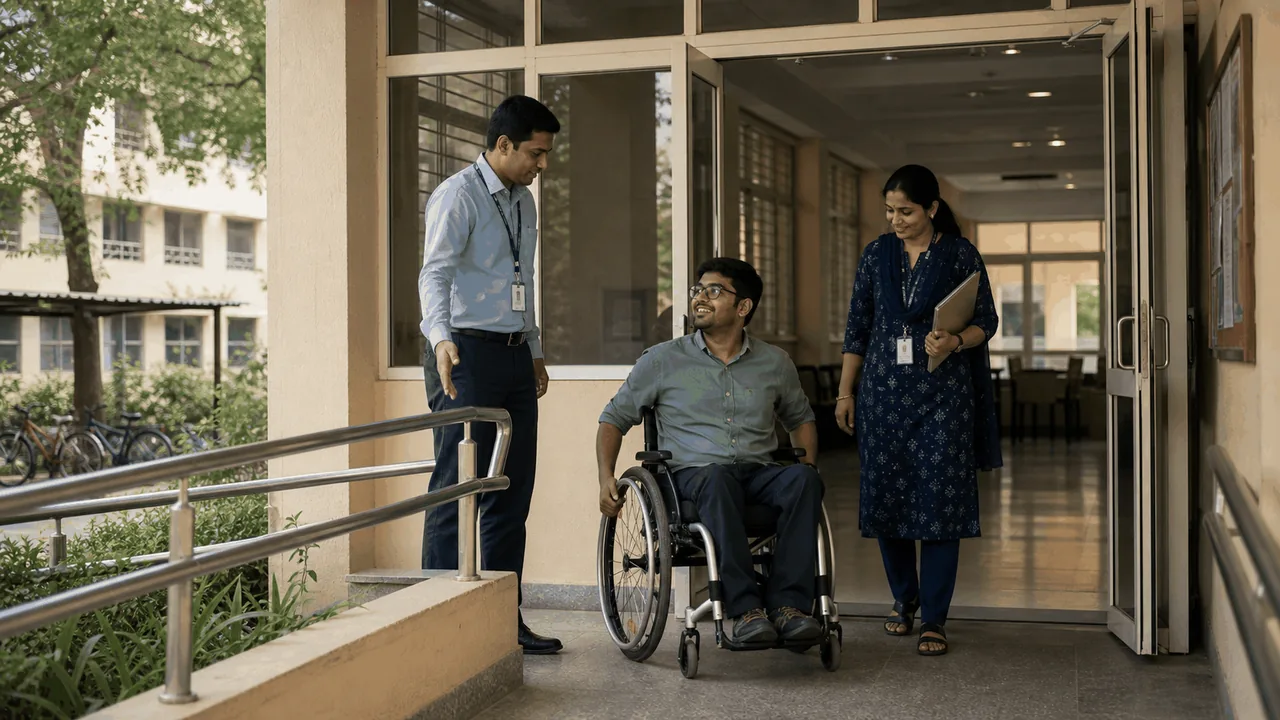
Accessibility is not an allotted room feature. It is an unbroken path through application, arrival, daily living, services, communication, emergency response and participation.
A nominally accessible room is of little use if the route, toilet, dining hall, laundry, help desk, digital portal or evacuation plan is inaccessible. Residential inclusion depends on both built environment and operating practice.
Universities should apply the Rights of Persons with Disabilities framework, notified higher-education accessibility standards and applicable building requirements with qualified accessibility and engineering review.
Map the complete resident journey
Review application, disclosure choices, room selection, arrival, keys and access, orientation, bathroom, dining, study, laundry, transport, complaints, social participation and checkout. Include physical, sensory, intellectual, psychosocial and temporary access needs.
Ask residents about barriers and preferred support rather than assuming a diagnosis determines one standard solution.
Create a timely accommodation process
Publish how to request an accommodation, acceptable information, decision authority, target timeline, interim arrangement, confidentiality and review route. Keep health information separate from general room-allocation records.
Plan capacity before admission peaks. A last-minute response can force unsafe or segregating choices even when the institution intends to help.
Maintain accessible infrastructure and services
Audit routes, gradients, doors, lifts, signage, lighting, alarms, toilets, furniture, service counters and common areas against current standards. Treat accessibility defects as priority service failures.
Provide accessible communication, documents and digital interactions. Staff should know respectful assistance and how to arrange interpreters, readers or other approved support.
Design inclusive emergency arrangements
Create person-centred emergency assistance plans where needed, with consent and periodic review. Use accessible alarms and professionally approved evacuation methods; do not assume a friend will provide rescue.
Include residents with disabilities in drills and after-action learning. A process that excludes them during practice will fail during an emergency.
Common failure modes to avoid
- Treating one ground-floor room as an accessibility programme.
- Requiring residents to disclose sensitive details to many staff members.
- Allowing lifts, accessible toilets or routes to remain out of service without alternatives.
- Providing academic accommodation but ignoring residential life.
- Designing emergency plans without the resident's participation.
Accessibility operations checklist
- Accessible inventory and route data are current.
- Accommodation requests have owners, timelines and interim options.
- Essential services and complaint channels are accessible.
- Maintenance priorities include access barriers.
- Emergency assistance and accessible alarms are reviewed.
- Residents with disabilities participate in audits and improvement decisions.
Frequently asked questions
Can a university ask for disability information? Collect only information necessary for the stated accommodation or safety purpose, explain its use and protect it under applicable law and policy.
Should all accessible rooms be reserved? Plan a transparent inventory and release strategy that protects genuine demand while avoiding unnecessary vacancy; involve the disability or equal-opportunity function.
Is providing an attendant enough? No. Personal assistance may be one approved support, but it does not remove the institution's duty to address inaccessible environments and services.
Conclusion
Accessible hostel operations make independence and participation ordinary. The strongest system removes barriers early, responds quickly to individual needs and treats accessibility as a continuing service standard.
Official references
- Primary sources for publication and implementation review (accessed 20 August 2026):
- India Code: Rights of Persons with Disabilities Act, 2016
- DEPwD: notified accessibility standards and guidelines, including higher education
- Bureau of Indian Standards: National Building Code of India 2016
- MeitY: Digital Personal Data Protection Act and policy material
- Implementation note: Operational guidance only. Confirm current central, state, local and university requirements and obtain qualified legal, clinical, fire-safety, accessibility or safeguarding review as applicable.
Revision history
Editorial language, consistency and source audit completed. India-specific operating context retained.
See something we should improve?
Point out a correction, add a missing perspective or share a stronger source.